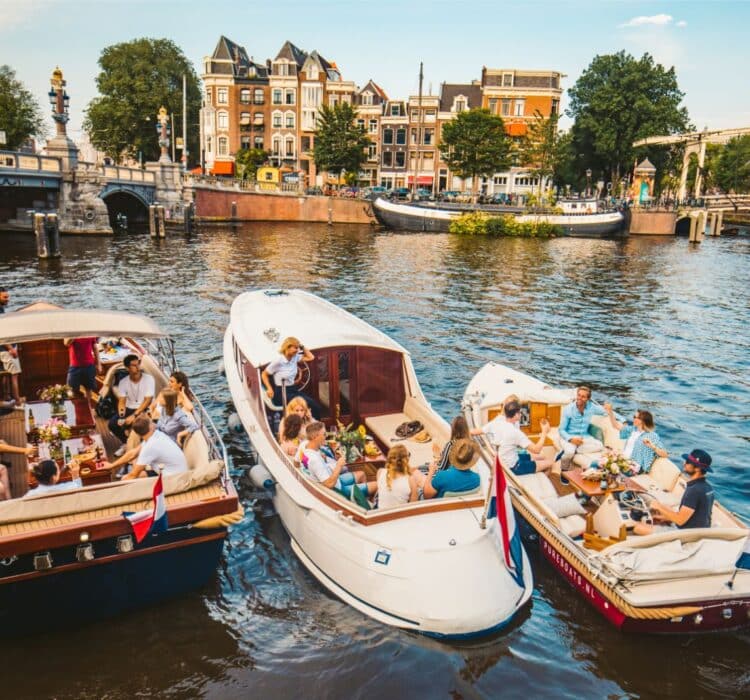
The best photography tips for Amsterdam sightseeing cruises come down to three essentials: use a fast shutter speed to counteract boat movement, shoot from a low angle to capture dramatic reflections, and time your cruise during golden hour for warm, cinematic light. These adjustments alone can transform ordinary snapshots into stunning canal photos.
Amsterdam’s canals offer a perspective most photographers never experience on foot. Shooting from water level opens up unique compositions with bridge arches, gabled facades, and shimmering reflections that define the city’s character. Whether you are using a smartphone or a professional camera, the tips below will help you capture images worth framing. From ideal camera settings and composition techniques to the best lighting windows and the most photogenic canal spots, each section answers a specific question to sharpen your Amsterdam canal cruise photography.
What Camera Settings Work Best on a Moving Canal Boat?
The best camera settings for canal boat photography prioritize a fast shutter speed of at least 1/250th of a second to freeze motion caused by the boat’s gentle rocking. Pair this with a wider aperture (f/4 to f/5.6) and let your ISO adjust automatically to maintain proper exposure in changing light conditions.
A moving boat introduces subtle vibrations that even steady hands cannot fully absorb. If you are shooting on a smartphone, tap the screen to lock focus on your subject and use burst mode to fire off several frames in quick succession. Most modern phones handle this well, but the extra frames give you options when reviewing them later.
For dedicated cameras, continuous autofocus (AF-C or Servo AF) keeps moving subjects sharp as you glide past bridges and houseboats. A stabilized lens or in-body image stabilization helps enormously, but it is not a substitute for a sufficiently fast shutter speed. When light is abundant, push the shutter speed even higher to 1/500th of a second for tack-sharp results.
- Shutter speed: 1/250s minimum, 1/500s in bright daylight
- Aperture: f/4 to f/5.6 for a balance of sharpness and background blur
- ISO: Auto, capped at 1600 to limit noise on older sensors
- Focus mode: Continuous autofocus for passing landmarks
- Stabilization: Enable optical or in-body stabilization if available
- File format: Shoot RAW if your camera supports it, giving you more flexibility in post-processing
One often overlooked setting is white balance. Amsterdam’s brick facades and tree-lined canals produce warm tones that auto white balance sometimes neutralizes. Setting white balance to “daylight” or “cloudy” preserves those rich, golden hues that make sightseeing cruise photo tips articles so appealing in the first place.
How Do You Compose Great Shots From Water Level?
Composing great shots from water level means using the canal surface as a natural leading line and placing the horizon in the lower third of your frame to emphasize Amsterdam’s tall, narrow canal houses and dramatic skies. The low vantage point from a boat creates a sense of intimacy and scale that street-level photography simply cannot replicate.
Use Reflections as a Compositional Tool
Water reflections are your most powerful creative asset during Amsterdam photography from the water. On calm stretches of canal, the surface mirrors bridges, trees, and facades almost perfectly. Position your camera so the reflection fills the bottom half of the frame, creating a symmetrical composition that draws the viewer’s eye into the scene. Early mornings and overcast days produce the stillest water and the clearest reflections.
Frame Through Bridge Arches
Amsterdam has more than 1,500 bridges, and many of them form natural frames for your photographs. As your boat approaches a bridge, shoot through the arch to capture the canal stretching into the distance beyond it. This technique adds depth and layers to your image. Hold your camera steady and fire just before you pass underneath for the best perspective. Including a sliver of the bridge’s stonework at the top of your frame grounds the composition and gives viewers a sense of place.
Beyond bridges, look for other framing opportunities: overhanging tree branches in summer, strings of lights during winter festivals, and the narrow gaps between moored houseboats. The key is to let Amsterdam’s architecture do the compositional work for you.
When Is the Best Light for Canal Cruise Photography?
The best light for canal cruise photography falls during golden hour, roughly the first hour after sunrise and the last hour before sunset, when warm, directional sunlight skims across the water and illuminates Amsterdam’s facades with a soft glow. In summer, this means early morning or late evening cruises; in winter, the lower sun angle provides flattering light for much of the afternoon.
Midday sun can be harsh, casting deep shadows under bridges and creating high-contrast scenes that are difficult to expose correctly. If your cruise happens during the middle of the day, overcast skies are actually your friend. Cloud cover acts as a giant diffuser, producing even, soft light that brings out the colors of Amsterdam’s painted canal houses without blowing out highlights.
For canal cruise lighting tips during the Amsterdam Light Festival season (typically running from late November through January), the rules change entirely. The best shots come after full darkness, when illuminated art installations reflect off the water. In these conditions, slow your shutter speed down to 1/30th of a second, brace your elbows on the boat’s railing, and raise your ISO to capture the glow. Smartphone users should switch to night mode for the best results.
Blue hour, the 20 to 30 minutes just after sunset, offers a particularly magical window. The sky turns a deep cobalt that contrasts beautifully with warm streetlights and glowing windows along the canals, creating Amsterdam boat tour photos with a moody, atmospheric quality that golden hour alone cannot match.
What Common Mistakes Ruin Canal Cruise Photos?
The most common mistakes that ruin canal cruise photos are shooting with digital zoom, neglecting to clean your lens, and trying to capture everything instead of being selective. These errors produce blurry, hazy, and cluttered images that fail to convey the beauty of what you actually experienced on the water.
- Using digital zoom: Pinching to zoom on a smartphone degrades image quality dramatically. Move your framing instead, or crop later in editing for a much sharper result.
- Dirty lens: Canal spray, fingerprints, and condensation accumulate quickly on a boat. Wipe your lens with a soft cloth before each shot, especially when transitioning between warm and cool air.
- Shooting only wide: Wide-angle shots of the canal are beautiful, but an entire gallery of them becomes monotonous. Mix in tight crops of architectural details, flowers on a windowsill, or your travel companion enjoying a glass of wine.
- Ignoring the background: Construction scaffolding, trash bins, and parked cars can sneak into canal photos. Shift your angle slightly or wait a moment for the boat to move past the distraction.
- Fighting the movement: Tensing up to hold the camera perfectly still often introduces more shake. Relax your arms, breathe out gently, and let your body absorb the boat’s motion naturally.
Another subtle mistake is over-editing. Amsterdam’s canals have a naturally rich color palette of red brick, green water, and warm stone. Heavy filters or extreme saturation push these colors into unrealistic territory. A light touch in post-processing, adjusting exposure and contrast while preserving natural tones, produces far more compelling results.
Which Spots Along Amsterdam’s Canals Are Most Photogenic?
The most photogenic spots along Amsterdam’s canals include the Seven Bridges view on Reguliersgracht, the Golden Bend on Herengracht, and the narrow Brouwersgracht, where light, water, and historic architecture converge in picture-perfect compositions. These locations are best experienced from the water, where you avoid the crowds and capture angles unavailable from the street.
Reguliersgracht and the Seven Bridges
Reguliersgracht is legendary among photographers. From a specific point on the water, you can see seven arched bridges receding into the distance, each one framing the next. This spot works beautifully in any light, but golden hour transforms it into something extraordinary. Your captain may slow the boat here, so have your camera ready as you approach.
The Golden Bend and Brouwersgracht
The Golden Bend on Herengracht features Amsterdam’s grandest canal houses, built by wealthy merchants in the 17th century. Their double-wide facades and ornate gables are stunning from water level, especially when afternoon light catches the sandstone details. Brouwersgracht, often called Amsterdam’s most beautiful canal, offers a quieter, more intimate atmosphere with converted warehouses and charming houseboats. Smaller boats can navigate these narrower waterways where larger tour vessels cannot reach, giving you unobstructed views and unique compositions.
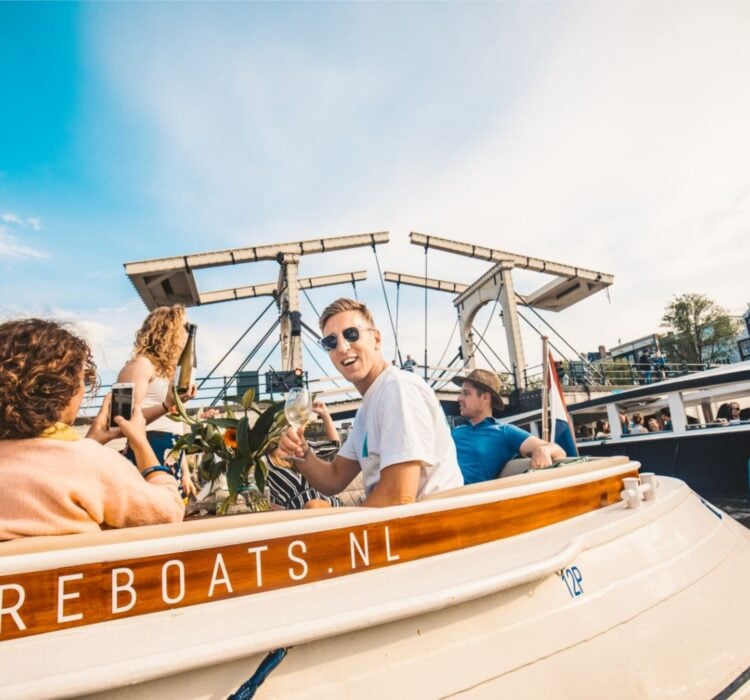
Do not overlook the Amstel River near the Magere Brug (Skinny Bridge), particularly at dusk when hundreds of tiny lights illuminate the bridge’s wooden structure. And during winter, the UNESCO-listed canal ring takes on an entirely different character, with bare trees and low light creating moody, atmospheric scenes perfect for black-and-white photography.
How Pure Boats Helps You Capture the Perfect Canal Photos
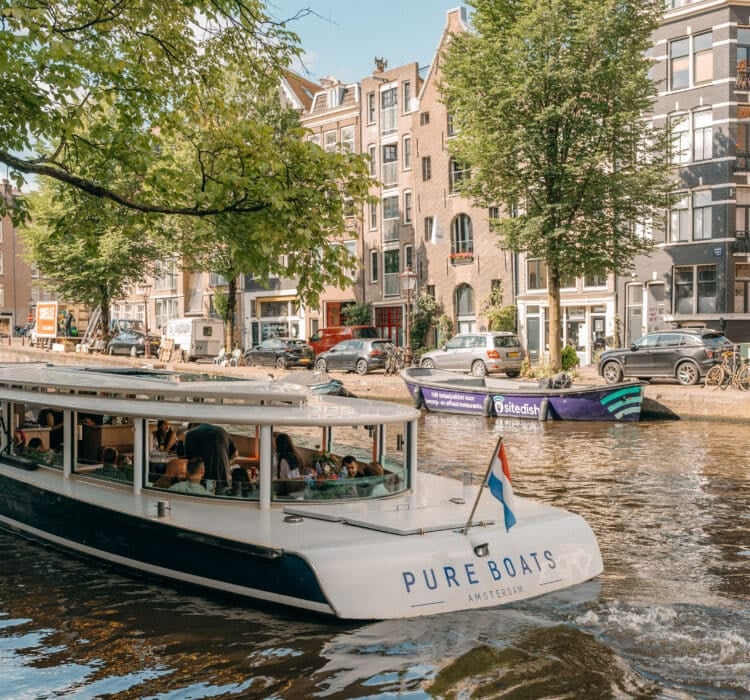
We designed our cruises to give you the best possible conditions for Amsterdam canal cruise photography, combining small groups, expert captains, and routes through the city’s most stunning waterways. Here is what makes cruising with Pure Boats ideal for photographers:
- Small group sizes (6 to 24 guests): Fewer people on board means more space to move around, find your angle, and shoot without elbows in the frame.
- Customized routes through narrow canals: Our captains navigate smaller waterways that large tour boats cannot access, bringing you closer to the architecture and hidden gems that make the best photos.
- Flexible pacing: Unlike scripted tours, our captains can slow down or pause near photogenic spots like the Seven Bridges on Reguliersgracht so you have time to get the shot.
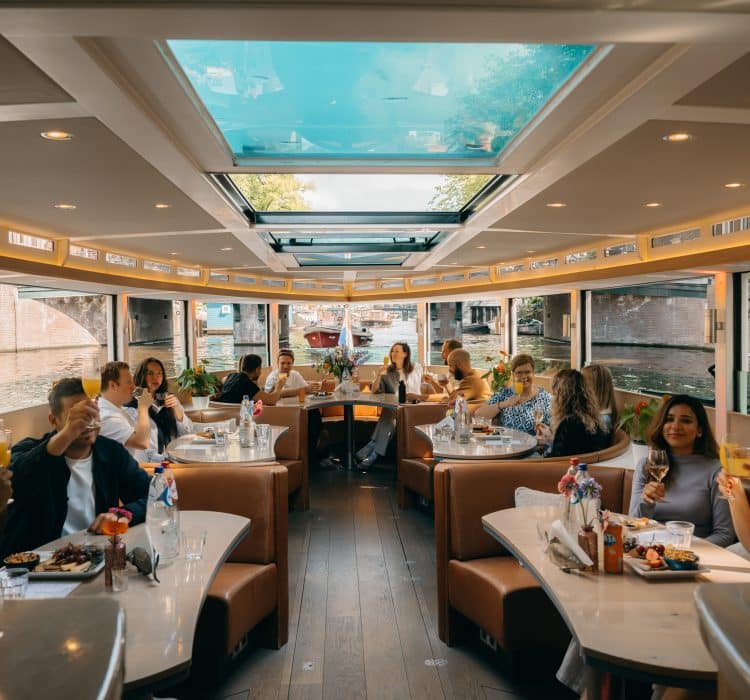
- Beautifully designed electric boats: Our handcrafted fleet, designed by superyacht specialists, runs silently and emission-free, meaning no engine vibrations to blur your images and no exhaust to cloud your lens.
- Golden hour and evening options: From our semi-private premium cruise aboard the iconic Stan Huygens to our Amsterdam Light Festival tours, we offer departures timed for the most dramatic lighting conditions.
Ready to capture Amsterdam from its most photogenic angle? Browse our cruise options and book the experience that fits your schedule. Bring your camera, bring your curiosity, and let the canals do the rest.
Veelgestelde vragen
What lens focal length is best for canal boat photography in Amsterdam?
A versatile zoom lens in the 24-70mm range is ideal for canal boat photography because it lets you quickly switch between wide establishing shots and tighter architectural details without changing lenses. If you only have a prime lens, a 35mm works well for capturing the full scene, while a 50mm is great for isolating specific facades and bridge details. Smartphone users can stick with the main wide camera and use the 2x optical zoom (if available) for tighter compositions rather than relying on digital zoom.
How do I protect my camera gear from water and spray on a canal cruise?
Bring a small microfiber cloth to wipe down your lens frequently, and keep your camera in a weather-sealed bag or a simple zip-lock bag when you are not actively shooting. Canal spray is minimal on most cruises, but condensation can form quickly when moving between the warm cabin and cool outdoor air, so give your gear a minute to acclimate before shooting. A UV or clear protective filter on your lens adds an inexpensive layer of defense against unexpected splashes.
Can I get good canal photos with just a smartphone, or do I need a dedicated camera?
Modern smartphones produce excellent canal cruise photos, especially in good light. The computational photography in recent iPhones and Android flagships handles tricky exposure situations like bright skies and shadowed canal walls better than many entry-level cameras. Focus on using burst mode, tapping to lock exposure on your subject, and keeping your phone steady against the boat’s railing for the sharpest results. The biggest advantage of a dedicated camera is low-light performance during evening or Light Festival cruises, where larger sensors capture significantly more detail.
How should I edit my Amsterdam canal photos after the cruise?
Start with straightening your horizon line, which almost always shifts slightly on a moving boat, then gently boost contrast and clarity to bring out architectural details in the brick and stonework. Free apps like Snapseed or Lightroom Mobile are excellent for this. Resist the temptation to oversaturate — Amsterdam’s natural color palette of warm brick, green water, and muted stone looks best with subtle adjustments to white balance and vibrance rather than heavy-handed filters.
What if my cruise is on a rainy or heavily overcast day — is it still worth photographing?
Absolutely. Overcast skies eliminate harsh shadows and create beautifully even lighting that makes the colors of Amsterdam’s painted canal houses pop. Rain adds texture to the water surface, creates moody reflections, and gives your photos an atmospheric quality that sunny-day shots often lack. Bring a compact umbrella or rain cover for your gear, and embrace the conditions — some of the most compelling Amsterdam canal photography comes from grey, drizzly days.
Should I sit on a specific side of the boat for the best photo opportunities?
There is no single ‘best side’ because photogenic landmarks appear on both banks throughout the cruise. If possible, choose a seat near the bow or at the back of the boat where you have a wider field of view and can pivot easily to either side. On Pure Boats’ smaller vessels, the intimate group sizes mean you can usually move around freely. If you know your route passes the Seven Bridges on Reguliersgracht, position yourself on the side facing the bridge sequence as you approach — your captain can often advise you in advance.
Is it worth booking a private or semi-private cruise specifically for photography?
A semi-private or private cruise is a significant upgrade for serious photographers because it gives you more control over pacing, fewer obstructions from other passengers, and the ability to request slow-downs or brief pauses at key spots. The smaller boats used for these cruises also access narrower canals where larger tour vessels cannot go, opening up exclusive compositions. If photography is a primary goal of your trip, the investment pays off in image quality and the overall experience of shooting without feeling rushed.